Product added to cart
Loading...
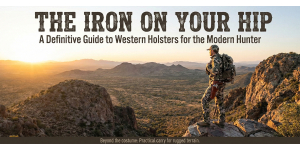
The Iron on Your Hip: A Definitive Guide to Western Holsters for the Modern Hunter
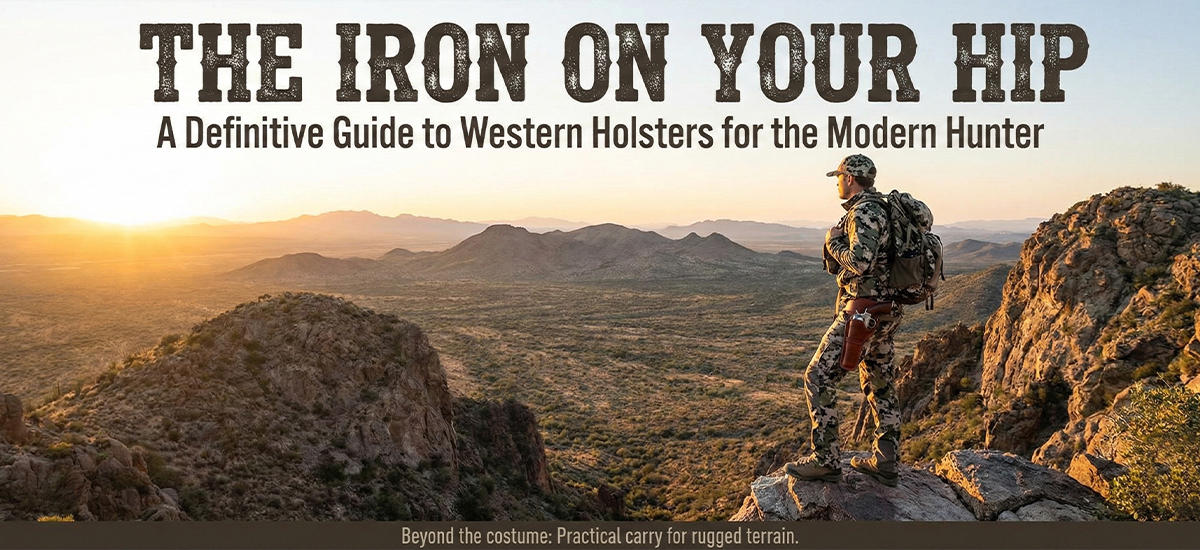
The Iron on Your Hip: A Definitive Guide to Western Holsters for the Modern Hunter
Western holsters are often treated as costume pieces, but in the field they are working equipment. A proper rig must keep a heavy revolver stable across uneven ground, remain accessible around pack belts and vehicle seats, and hold its shape well enough to support safe, consistent re-holstering.
This guide breaks down the most common western holster styles, the leather and construction details that matter outdoors, and the carry configurations hunters actually live with—strong-side, cross-draw, and chest carry.
Part I: The Anatomy of a Legend — History and Holster Types
Western holster terminology is frequently misused. “Buscadero,” “Slim Jim,” and “Mexican Loop” refer to different constructions with different strengths and drawbacks.
1) The Buscadero: Iconic Look, Field Compromises
The Buscadero is the classic “low-slung” movie rig. The holster hangs lower than the belt line, typically via a slot/dip in the belt, and is often stabilized with a leg tie.
Why hunters should think carefully about it:
Movement stability: A low-riding holster can swing more during steep climbs, running, and brush work unless secured very well.
Vehicle comfort: Lower rigs can bump seats and consoles and may shift awkwardly when seated.
Best use case: Range or casual carry where aesthetics matter more than long-distance stability.
2) Traditional High-Ride Designs: Mexican Loop and California Pattern (Slim Jim)
These classic patterns generally ride higher and closer to the body than Buscadero rigs.
California Pattern / “Slim Jim”
A form-fitted, slim sleeve profile with a stitched belt loop on the back.
Often associated with earlier frontier carry and practical protection for the revolver in dusty, wet conditions.
Mexican Loop
Typically built with a skirt and loop system that helps accommodate wider belts.
Commonly favored for stability because the broad skirt and belt contact area help resist “flop.”
Why this matters for hunters:
High-ride traditional designs tend to stay tighter to the center of gravity, reducing snagging and impact against the leg in dense cover.
3) Ride Height as a Field Spec: The “Drop Loop” Concept
In modern discussions, “drop loop” often means a holster that sits lower than a strict high-ride, but still attaches in a way intended to remain stable.
For hunters, ride height is functional:
Too high: interferes with pack belts, coat hems, or layered clothing.
Too low: interferes with sitting, climbing, and can increase snagging.
A practical target: a mid-ride that keeps the grip accessible while clearing pack belts and winter layers.
Table 1: Functional Comparison of Western Holster Architectures
| Feature | Buscadero Rig | Mexican Loop / Traditional | Slim Jim / California Pattern |
|---|---|---|---|
| Belt attachment | Holster hangs lower (often via belt slot/dip) | Skirt + loop system stabilizes on belt/hip | Sewn/riveted loop on holster back |
| Ride height | Low | High to mid | High |
| Stability while moving | Lower unless tie-down is used well | High | Moderate (depends on belt width/fit) |
| Backpack integration | Often clears pack belt | Often conflicts with pack belt | Often conflicts with pack belt |
| Vehicle comfort | Often awkward seated | Moderate | Moderate |
| Best use | Style/fast-draw oriented setups | Hunting/field stability | Traditional profile; lighter field use |
Part II: The Science of Leather — Material Selection for the Field
A western holster is only as dependable as its leather and construction. Hunters should evaluate leather by tanning method, thickness, structure, and finishing—not by marketing labels.
1) Vegetable-tanned vs. Chrome-tanned Leather (What Matters for Holsters)
Vegetable-tanned leather (veg-tan) is widely preferred for structured holsters because it can be wet-formed to a specific firearm and retains its shape once dried. This supports:
a more consistent draw,
passive retention via molding,
and a holster mouth that stays open more reliably.
Chrome-tanned leather is typically softer and more flexible. That’s not automatically “bad,” but soft, collapsible holsters create safety and handling problems, especially during re-holstering and when debris or material can deform near the trigger guard.
Field takeaway: If you want a western holster that keeps its structure and retention over time, start with firm veg-tan and good stitching.
2) Leather Weight and “Skirting” Leather for Heavy Revolvers
Leather is commonly measured in ounces (oz), where 1 oz is approximately 1/64 inch in thickness.
General guidance for hunting holsters:
8–10 oz for many revolvers and general field use
10–12 oz or lined construction for heavier magnums / large-frame revolvers
Belts: often 12–14 oz or a double-layer belt for proper load support
Skirting leather (often used in saddle work) is frequently chosen for gun belts and heavy holsters because it’s built for load-bearing structure.
3) Dye Penetration and Abrasion Reality
In brush country, holsters get scratched. Finishes vary:
Some leathers show lighter color beneath surface wear.
Deeper dye penetration tends to reduce how visible scratches appear.
The goal is not “perfect appearance,” but consistent structure and stitch integrity after abrasion.
4) Lining: Benefits and Trade-offs
A lined holster adds a second layer inside the pouch. Potential benefits:
improved rigidity,
reduced warping,
and a smoother interior draw surface.
Trade-off to consider: any lining can trap fine dust if not cleaned and maintained. Hunters in gritty environments should prioritize simple cleaning habits and avoid storing firearms long-term inside leather.
Part III: Carry Configurations — Biomechanics in the Field
No single carry position is “best.” The right choice depends on packs, vehicles, terrain, and whether the handgun is a primary hunting tool or a secondary defensive tool.
1) Strong-Side Hip Carry
Pros
Natural draw path for most shooters
Simple and familiar
Common hunter problems
pack waist belts compete for the same real estate
heavy clothing can cover or restrict access
seated access can be compromised
2) Cross-Draw Carry
Cross-draw places the holster on the non-dominant side with the grip angled forward.
Why many hunters like it
easier access while seated (truck, ATV, saddle)
can reduce interference with a rifle slung on the dominant side
may be easier to position around pack components, depending on belt and buckle layout
3) Chest Rigs (Modern Field Standard for Many Hunters)
Chest carry is often chosen for:
pack compatibility (independent of the waist)
consistent access in steep terrain
improved seated access
keeping the handgun above brush and snowline
Hunters who frequently drop packs, climb into vehicles, or operate in thick cover often find chest carry the least compromised configuration.
Table 2: Carry Position Analysis for Hunters
| Scenario | Strong Side Hip | Cross Draw | Chest Rig |
|---|---|---|---|
| Backpacking (heavy pack) | Poor to moderate | Moderate | Excellent |
| Horseback riding | Moderate | Excellent | Good (check saddle clearance) |
| ATV / truck driving | Poor | Excellent | Excellent |
| Defensive access | Fast | Moderate | Fast, consistent while moving/seated |
| Long-duration comfort | Moderate | Moderate | High (weight distribution depends on harness fit) |
Part IV: The Single-Action Revolver — Holster-Relevant Considerations
Western holsters and single-action revolvers are closely linked, but the field considerations are practical, not nostalgic.
1) Safety Systems and Carry Condition
Single-action revolvers vary by design. Some modern actions incorporate safety mechanisms (such as transfer bar systems), while many traditional-pattern revolvers do not.
Field principle: Always follow the manufacturer’s safety guidance for your specific revolver. If your revolver’s safe carry method reduces capacity, accept the trade—holster carry on rough terrain demands conservative safety habits.
2) Barrel Length vs. Carry Reality
Longer barrels can improve handling characteristics and sight radius, but they also:
increase holster length and seated interference,
reduce comfort in vehicles,
and can complicate high-ride belt carry.
Hunters who use longer barrels often find cross-draw or chest carry more practical than strict high-ride strong-side carry.
3) Retention Mechanisms: Passive vs. Positive
In brush, gravity and impact are not theoretical. Consider:
molded passive retention (fit and friction)
hammer thong (quiet, traditional, requires practice)
snap strap (positive security for active movement)
adjustable tension (helpful as leather breaks in)
Part V: Maintenance — Break-In and Long-Term Care
Leather is durable, but it is not maintenance-free.
1) Break-In: Controlled Stretching (Not Soaking)
A quality holster may arrive tight by design. A common break-in approach is a controlled, minimal stretch (for example, a thin barrier around an unloaded firearm) to ease initial fit.
Avoid shortcuts:
soaking in water, alcohol, or heavy oiling can reduce structure and retention—exactly what hunters need most.
2) Conditioning: Protect Without Softening
Over-conditioning can soften leather and reduce retention. Hunters should use light, appropriate leather care and avoid saturating oils intended to dramatically soften leather goods.
3) Sweat, Salt, and Hardware Checks
After a hunt:
wipe down leather to remove sweat/salt
check screws/fasteners for loosening from vibration
store leather dry, away from prolonged heat sources
Storage note: Do not store a firearm in a leather holster long-term. Leather can retain moisture and residues that encourage corrosion and surface staining.
Part VI: Buying Checklist — What to Look for in a Western Hunting Holster
Use this checklist to evaluate a rig before trusting it outdoors:
Firm, structured leather suitable for molding and shape retention
Reinforced mouth / consistent opening for safer re-holstering
Retention appropriate to terrain (strap/thong if needed)
Ride height compatible with your pack and clothing
Belt compatibility (width and stiffness that supports a heavy revolver)
Stitching and edge finishing that won’t unravel after abrasion
Carry position matched to use (vehicle-heavy days often favor cross-draw or chest carry)
Technical Appendix: Quick Reference Guides
Table 3: Holster Troubleshooting Guide
| Symptom | Likely Cause | Practical Fix |
|---|---|---|
| Holster collapses when gun is drawn | Leather too soft or construction not reinforced | Replace or move to a structured holster design |
| Gun is extremely tight | Normal new-holster fit | Use controlled break-in; avoid soaking/oiling |
| Holster swings/flops | Ride too low or insufficient stabilization | Raise ride height, add stabilization, or change design |
| Ammo slips from loops | Loops stretched or wrong size | Use correctly sized loops; avoid forcing wrong calibers |
| Green residue on gun/brass | Reaction with leather residues + moisture | Clean promptly; avoid long-term storage in leather |
Table 4: Practical Leather Weight Guidance (Typical Ranges)
| Use Case | Example | Typical Leather Approach |
|---|---|---|
| Light/medium revolver field carry | .22 LR, .357 Mag | 8–9 oz (structured) |
| Standard revolver hunting/field use | .44 Special, .45 Colt | 9–10 oz or lined |
| Heavy revolver / harsh terrain | .44 Mag, .454 Casull | 10–12 oz or lined + reinforced mouth |
| Gun belt | All | 12–14 oz or double-layer belt |