Product added to cart
Loading...
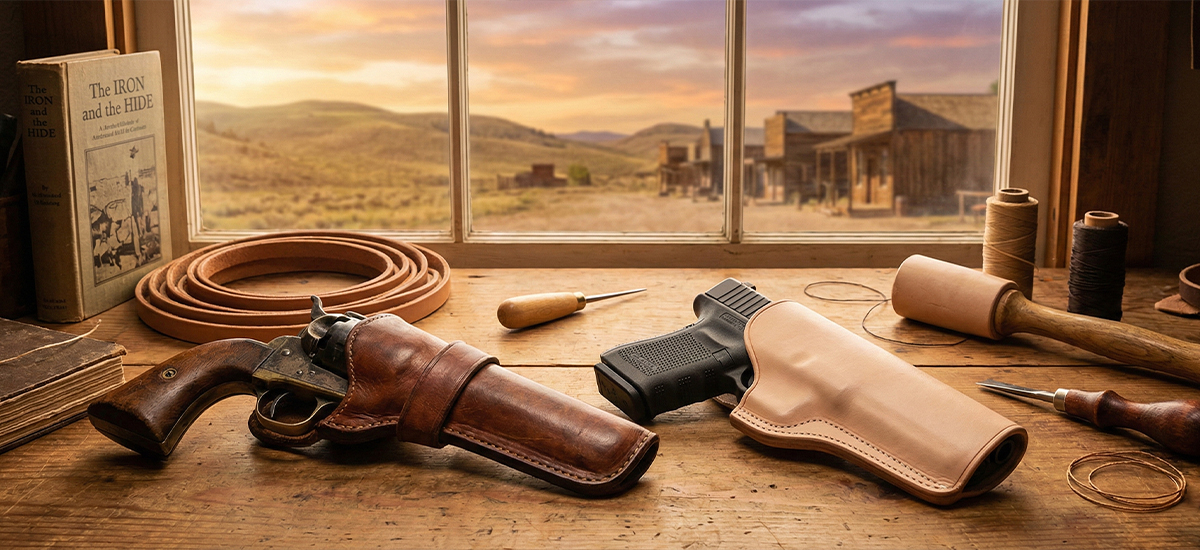
The Iron and the Hide: An Exhaustive Chronicle of the Leather Holster, Its History, Mechanics, and Enduring Purpose
Introduction: The Tether Between Man and Steel
In the history of firearms, the holster is often treated as a secondary accessory—overshadowed by the weapon it carries. This view ignores a fundamental reality: a firearm has no practical value if it cannot be carried securely, accessed reliably, and retained safely. The leather holster is not merely a container; it is the functional interface between rigid steel and the moving human body.
Unlike modern synthetics, leather is organic and responsive. It reacts to heat, sweat, pressure, and time. A quality leather holster begins stiff and unyielding, then gradually conforms to its user, developing patina and character that reflect years of use. It is not static equipment—it is a working object that matures.
This article serves as a comprehensive reference on leather holsters, tracing their evolution from early cavalry use to modern concealed carry. It examines historical development, material science, biomechanics, design philosophy, maintenance practices, and the enduring relevance of leather in a polymer-dominated world.
Part I: The Genesis of Gunleather – A Historical Evolution
The Era of the Saddle: Pommel Holsters
In the early 19th century, pistols were heavy, large-caliber tools designed primarily for mounted combat. Carrying them on the waist was impractical. As a result, early holsters were saddle-mounted pommel holsters—deep leather buckets draped over a horse’s saddle horn.
These holsters prioritized protection over speed. Thick leather, full flaps, and deep cavities shielded delicate lock mechanisms from moisture and debris. Access required deliberate, two-handed motion. This design reflects a time when pistols were secondary weapons, used only in close quarters after primary arms failed.
The California Gold Rush and the “Slim Jim”
The Gold Rush era introduced a new problem: personal defense while dismounted. In crowded mining camps and frontier towns, firearms had to be worn on the body.
The California Pattern holster—commonly called the “Slim Jim”—was the first true body-worn holster. It was slim, contoured, and sewn to follow the revolver’s profile. High leather walls protected percussion caps, while the open top allowed faster access than military flap holsters.
This design marked the transition from equipment-based carry to personal carry.
Metallic Cartridges and the Mexican Loop
The introduction of metallic cartridges in the late 19th century changed everything. Ammunition belts became wider and heavier, making earlier narrow-loop holsters impractical.
The Mexican Loop holster solved this by using a backing skirt with integrated loops that accommodated wide cartridge belts. Beyond function, the large leather skirt became a canvas for tooling, carving, and decoration. Holsters evolved into status symbols—functional art worn on the hip.
The Buscadero Myth
The low-slung “Buscadero” rig popularized by Western films is largely a Hollywood invention. Historically, working gunmen carried holsters high on the waist for stability and practicality.
Low-hanging rigs snagged on brush, bounced while riding, and risked losing the firearm. The Buscadero emerged in the 20th century as cinematic costuming designed to exaggerate draw speed and visual drama, not historical accuracy.
The 20th Century Shift: Threepersons and the FBI Cant
As lawmen transitioned from horseback to automobiles, holster design adapted again. Tom Threepersons, a lawman and Prohibition agent, worked with saddlers to create a stripped-down, high-ride holster that exposed the trigger guard and cylinder.
This design introduced forward cant—later known as the “FBI Cant.” By angling the grip forward, the holster improved concealment and accessibility while seated. This geometry remains the standard for modern OWB concealment holsters.
Part II: The Alchemy of Leather – Material Science and Tanning
Vegetable Tanning: The Holster Standard
Vegetable-tanned leather is essential for holster construction. Tanned using natural plant tannins, this slow process preserves fiber integrity and allows leather to be wet-molded.
Key advantages:
Can be shaped precisely to the firearm
Retains molded form permanently
Maintains stiffness for safe re-holstering
Develops natural patina over time
Chrome Tanning: Why It Fails for Holsters
Chrome-tanned leather is fast-produced, soft, and flexible—qualities desirable for clothing but unsuitable for holsters.
Limitations:
Lacks structural rigidity
Collapses when the firearm is drawn
May retain chemicals that accelerate corrosion
Chrome leather is unsuitable for holster bodies and should only be used, if at all, as a non-structural lining.
Cowhide vs. Horsehide
Cowhide remains the industry standard due to availability and workability. Horsehide, however, offers denser fiber structure and superior moisture resistance.
Horsehide advantages:
Better sweat resistance
Thinner for equivalent strength
Longer shape retention
This makes horsehide particularly effective for inside-the-waistband carry in humid environments.
Exotic Leathers: Functional, Not Just Decorative
Sharkskin: Exceptional abrasion resistance due to denticle structure
Elephant hide: Extremely tear-resistant, ideal for hard-use field holsters
Alligator/Crocodile: Primarily aesthetic, requiring careful conditioning
Exotics are typically overlays bonded to a veg-tan core for structural integrity.
Part III: The Architecture of Concealment – Design and Biomechanics
IWB Carry: Concealment Through Geometry
Inside-the-waistband holsters rely on body pressure and clothing to conceal the firearm.
Key features:
- Rough-out exterior for grip against clothing
- Sweat shield to protect firearm and wearer
- Reinforced mouth for safe re-holstering
OWB Carry: Comfort and Accessibility
Outside-the-waistband holsters prioritize comfort and draw speed.
- Pancake holsters pull the firearm tight against the body for concealment
- Avenger holsters offer fast access but less body conformity
Reinforced Mouth: A Safety Requirement
A collapsing holster mouth creates a serious safety hazard. Quality leather holsters use reinforced rims—extra leather layers or internal stiffeners—to ensure one-handed re-holstering without risk.
Part IV: Leather vs. Kydex
Leather and Kydex represent different philosophies.
| Feature | Leather | Kydex |
|---|---|---|
| Retention | Friction-based | Mechanical “click” |
| Comfort | Superior | Rigid |
| Finish Wear | Low (clean) | High |
| Maintenance | Required | Minimal |
| Lifespan | Decades | Indefinite |
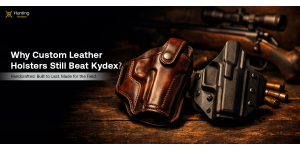
Leather excels in comfort and concealment; Kydex dominates uniformity and environmental resistance.
Part V: Break-In and Maintenance
Proper Break-In
Leather holsters are intentionally tight. The recommended method:
Ensure firearm is unloaded
Wrap in thin plastic
Insert fully and leave overnight
Repeat if necessary
Never use water, oil, or heat.
Maintenance Guidelines
- Wipe salt and sweat with a damp cloth
- Apply microcrystalline wax annually
- Avoid oils that soften leather
- Do not store firearms long-term in leather holsters
Conclusion: The Enduring Companion
A Kydex holster is a tool. A leather holster is a companion.
Leather demands care, patience, and understanding—but rewards the user with unmatched comfort, adaptability, and longevity. It molds to the body, records its service through patina, and often outlasts the firearm it carries.
For those seeking pure efficiency, plastic suffices. For those who value craftsmanship, longevity, and a carry system that evolves with its owner, leather remains unmatched.